Cut Worst Case Waits: Schedule Conflict Management for Youth Leagues
Cut Worst Case Waits: Schedule Conflict Management for Youth Leagues
The fastest way to prevent and resolve league scheduling conflicts is a centralized, constraint-aware master schedule built on enforced availability deadlines, with one person owning triage and publish decisions. Constraint-based scheduling approaches can process hundreds of teams with far fewer violations than manual spreadsheets, according to constraint programming research. Platforms like SportChatPro build this discipline into the software itself.
TL;DR:
- Scheduling software that integrates venue, team, and referee data can resolve conflicts within minutes, especially for leagues with more than 50 teams.
- Building a schedule involves defining constraints, validating availability, and using a two-phase approach of tiling and local search to avoid violations.
- During the season, quick fixes like same-division swaps or moving games to neutral sites are preferred over improvisation, with clear communication and logging.
- Prioritizing minimization of the maximum waiting time for any team reduces family complaints more effectively than achieving perfect overall balance.
- Manual spreadsheets become inefficient and risk conflicts at larger scales, making constraint-based scheduling tools essential for effective league management.
Table of Contents
- Pre-Publish Checklist: Stop Conflicts Before They Start
- Building the Master Schedule: From Raw Availability to Publish Day
- Resolving Conflicts Once the Season Starts
- Constraints and Fairness Metrics That Define a Good Schedule
- Deciding When to Bring In Scheduling Software
- What League Operators Consistently Get Wrong
- How SportChatPro Handles the Scheduling Work Described Here
- Sources
- FAQ
Pre-Publish Checklist: Stop Conflicts Before They Start
Most schedule conflicts trace back to missing or late information, not bad luck. A short pre-publish checklist closes the gaps that cause double-bookings, referee shortages, and last-minute forfeits.
- Collect firm availability windows from teams, venues, and referees, with a hard submission deadline and no exceptions for late replies.
- Record field capacity (how many games can run per time slot) and the required rest window between games for each team.
- Separate hard constraints, things that must never be violated, from soft constraints, things you would prefer but can trade off.
- Assign a single triage owner who approves every schedule change once the season starts, so no two people make conflicting fixes.
- Build in an internal review window before the public release, and lock the publish date so families know exactly when to expect it.
Skipping any one of these tends to resurface as an in-season emergency. Coupling referee availability with field bookings early, rather than treating them as separate problems, is one of the most common fixes practitioners rely on according to youth sports league scheduling research.
Building the Master Schedule: From Raw Availability to Publish Day
Turning raw availability data into a workable schedule is a sequence, not a single step. Each stage catches a different category of conflict before it reaches families.
- Define the scheduling window, slot lengths, and the minimum rest time between games for any team (commonly one game length, referred to as γ).
- Gather validated availability from teams and confirmed calendars from venues, then map referee categories to the slots they are certified to cover.
- Tile rounds into the schedule greedily, placing the hardest-to-fit games first to minimize hard-constraint violations early.
- Run an automated constraint-based generator or scheduling heuristic, then inspect the output for waiting-time fairness across teams.
- Apply local-search swaps, home and away swaps, round swaps, or partial swaps, to bring down penalty points without breaking hard constraints.
- Freeze the schedule, publish it with a visible version number, and post the change policy alongside it.
This two-phase pattern, tiling followed by local-search repair, is a practical approach for volunteer-run leagues because it avoids heavy computation while still producing a workable, fair schedule, according to youth sports scheduling research.
Pro Tip: Run your constraint pass at least 48 hours before your internal review window closes, so swaps have room to happen without touching the published version.
Resolving Conflicts Once the Season Starts
Even a well-built schedule hits live conflicts: a field closes, a team withdraws, a referee cancels. What matters is having a fixed playbook instead of improvising each time.
- Triage first: classify the conflict by severity and identify which hard constraints, venue capacity, referee certification, team double-booking, are actually at risk.
- Try quick fixes before escalating: swap games within the same division and round, move to a neutral site, or reassign a referee who matches the required certification level.
- Escalate only when swaps fail: fall back on pre-agreed make-up windows or a limited-forfeit policy that both teams accepted before the season began.
- Communicate clearly: name who updates the schedule, how families are notified, and how fast they can expect a fix, ideally within a fixed number of hours.
- Log everything: keep a changelog with a rollback option so any change can be traced and reversed if it creates a new conflict.
Referee shortages are one of the most disruptive conflicts because certification levels limit who can cover a slot. Coupling referee categories with venue bookings in the master schedule, rather than fixing referee gaps after the fact, prevents most of these last-minute scrambles, per the same youth league scheduling research.
Constraints and Fairness Metrics That Define a Good Schedule
Not every rule in a schedule carries the same weight. Hard constraints must hold: no team plays two games at once, no field hosts more games than its capacity allows, and no referee works outside their certification. Soft constraints are preferences you trade off: minimizing waiting time between a team’s games, controlling travel distance, and balancing home and away patterns across the season.
- Hard constraints: venue availability, no team double-booked, referee certification matched to the slot.
- Soft constraints: minimize total waiting time, minimize travel distance, balance home and away games.
- Fairness metrics: total waiting time, maximum waiting time, and number of breaks between games.
Minimizing the maximum waiting time any single team experiences matters more for family satisfaction than minimizing the total across all teams, because a schedule can look fair on average while still leaving one team sitting idle for hours, a pattern linked to family burnout in overscheduled youth sports. Treat capacity and referee matching as hard rules, then tune penalty weights on waiting time and travel until complaints drop.
Deciding When to Bring In Scheduling Software
Manual spreadsheets hold up for small, single-division leagues. Once you are coordinating 50 to 200 or more teams across shared venues, or juggling multiple divisions on the same fields, the combinations get too large to repair by hand without introducing new conflicts.
- Look for a master schedule view, venue capacity modeling, and referee-coupled scheduling in any tool you consider.
- Publish controls and audit logs matter as much as the schedule itself, since they prevent silent, untracked edits.
- Rapid rescheduling, the ability to regenerate a single round without breaking the rest, saves the most admin time in-season.
Constraint-based tiling combined with local-search repair, the same two-phase method described above, is what lets software resolve waiting-time and capacity violations in minutes rather than hours. Some scheduling platforms are built specifically from youth sports league operations, with conflict-aware scheduling that accounts for team availability and facility limits together rather than as separate steps.
Pro Tip: When you first bring in a scheduling tool, import your availability data, run one constraint pass, and review only the swaps it suggests before touching anything else.
What League Operators Consistently Get Wrong
The instinct in most leagues is to optimize for a perfectly balanced schedule and worry about conflicts later. That gets the priority backward. A schedule that minimizes the worst-case wait for any one team, even if it is not perfectly balanced on paper, generates far fewer complaints than one that looks fair in aggregate but leaves a handful of families stranded at the field. Publish controls and a single triage owner matter more than any algorithm: most in-season chaos comes from untracked edits, not bad math.
— Cameron
How SportChatPro Handles the Scheduling Work Described Here
Some platforms are built around workflows like those described here: a centralized master schedule, availability and venue data pulled into one system, and intelligent scheduling that weighs team needs and facility limits together instead of as separate checklists. Publish controls and continuity tools carry schedules from one season into the next, cutting the administrative rebuild every new season usually demands. 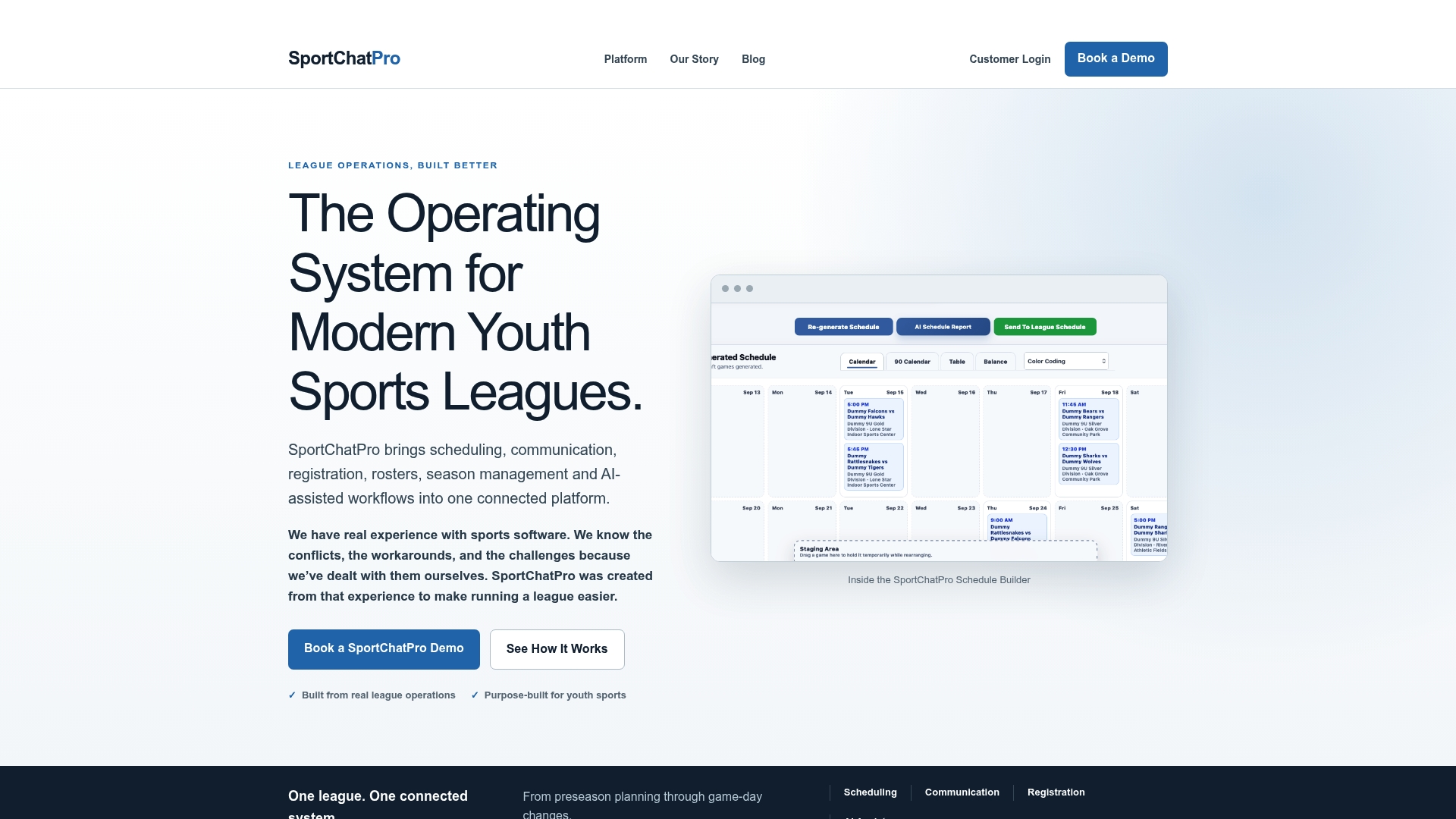

Learn more about how the SportChatPro platform handles conflict-aware scheduling, or visit the product page to request a demo.
Sources
- Soccer tournament scheduling using constraint programming
- Overscheduling activities can cause burn-out for children and parents — UAB News
FAQ
What is the fastest way to prevent schedule conflicts?
The fastest way is a centralized master schedule built from validated availability data, with hard deadlines and a single triage owner managing all changes. This stops the most common cause of conflicts: late or missing information reaching the person building the schedule.
How do you resolve a double-booked field mid-season?
Triage the conflict first to see which hard constraints are at risk, then try a same-division round swap or move one game to a neutral site. If no swap works, fall back on a pre-agreed make-up window rather than improvising a new rule mid-season.
What is waiting time and why does it matter in scheduling?
Waiting time is the gap a team spends idle between its own games in a tournament or round. Minimizing the maximum waiting time any single team faces reduces family complaints and organizer burnout more effectively than minimizing the average across all teams, according to research on overscheduled youth sports.
When should a league switch from spreadsheets to scheduling software?
Leagues coordinating 50 to 200 or more teams across shared venues typically outgrow manual spreadsheets, since the number of combinations makes manual repairs risky. At that scale, constraint-based tools like SportChatPro resolve capacity and referee conflicts in minutes instead of hours.
What should a schedule change policy include?
A change policy should name who is authorized to make edits, how families are notified, and the expected turnaround time for a fix. Keeping a changelog with a rollback option keeps every edit traceable and prevents one fix from creating a new conflict.