Youth League Scheduling: Rules First Checklist for Volunteers
Youth League Scheduling: Rules First Checklist for Volunteers
Before you touch the calendar, collect the facts and write the rules that the schedule must obey. Gather field hours, team counts, coach conflicts, and blackout dates, then confirm the pitch-count and rest requirements that Little League Regulation VII lays out for regular-season play. Once the rules are set, generate the full season at once and publish it in a single place with a stated change policy; scheduling tools exist specifically to hold that structure together.
TL;DR:
- Scheduling more than 12 games requires careful planning of field hours, team conflicts, and rest requirements to ensure safety and fairness.
- Sharing fields among multiple leagues demands joint coordination of prime slots, buffers between games, and conflict detection to avoid capacity violations.
- Building the entire season at once helps identify interdependencies early, reducing mid-season conflicts and last-minute adjustments.
- Implementing a clear change policy and publishing in a single, versioned schedule minimizes confusion and streamlines updates for families and officials.
- Cost factors like field rental, referee fees, and lighting are directly affected by the schedule’s structure, making early budget alignment crucial.
Table of Contents
- Collect the inputs you need before scheduling
- Write the rules that make the schedule hold
- Build the season as a whole
- Shared fields, referees and capacity: detect and resolve conflicts
- Publish once, with a clear change policy and communication plan
- Weather, rainouts and rescheduling rules
- Practical checklist and time-saving tips
- Cost considerations and budgeting for scheduling resources
- Timeline overview for the scheduling process
- Best practices for stakeholder engagement and feedback
- Why rules-first scheduling scales
- How SportChatPro supports a rules-first schedule
- Primary sources and further reading
- Sources
- FAQ
Collect the inputs you need before scheduling
A schedule fails when it is built on guesses, not facts. Before you assign a single game, pull together every constraint that will limit where games can go.
Start with facility data: field identifiers, daily available hours, lighting for evening games, and setup or teardown windows between games. Add blackout dates for holidays, tournaments, or facility closures.
Next comes the team side of the ledger.
- Confirm division and team counts, plus the guaranteed number of games each team is owed for the season.
- Flag coaches who run more than one team, since their conflicts will limit which slots actually work.
- Note travel distance between fields when teams share coaches or facilities across town.
- Lock in game length, including warm-up and turnover time, and decide whether doubleheaders are allowed.
- Capture referee or umpire availability alongside any permit windows tied to the fields themselves.
Keep all of it in one shared spreadsheet or scheduling platform. Scattered notes in group texts and email threads are the single biggest reason schedules need mid-season fixes.
Write the rules that make the schedule hold
Inputs tell you what is possible. Rules tell you what is acceptable, and youth sports carries a safety dimension that adult leagues do not.
Start with volume. Little League Regulation VII requires local leagues to schedule a minimum of 12 regular-season games per team, and many leagues build toward roughly two games per week to hit that floor comfortably.
Little League requires at least 12 regular-season games per team, a baseline that shapes how many weeks a season needs and how much field time a league must secure, according to Regulation VII.
From there, codify the rules that keep the schedule safe and fair.
- Set pitch-count thresholds and mandatory rest days for youth pitchers, and forbid pitching on three consecutive days.
- Cap games per day per team and decide your doubleheader policy in writing, not on the fly.
- Set earliest and latest start times by age group so younger divisions are not scheduled past reasonable bedtimes.
- Define home and away balance and how prime evening or weekend slots rotate across teams and divisions.
Build the season as a whole
Building week by week feels manageable, but it creates interdependencies that surface as conflicts weeks later. Generating the whole season at once catches those problems before anyone has committed to a date.
- Choose a format: single round-robin for shorter seasons, double round-robin for longer ones, or a split season with a break for tournaments.
- Decide the home-away pattern for each division so no team gets stuck with a lopsided run of road games.
- Block recurring slots first, the standing Tuesday and Saturday windows each division owns, before filling in the exceptions.
- Build out full rounds, then seed playoff brackets once pool play is set.
- Reserve makeup slots inside the season rather than tacking them on at the end, where field time is scarcest.
Allocating prime slots by division, rather than by whoever asks first, cuts down on the venue capacity violations that force last-minute rewrites.
Shared fields, referees and capacity: detect and resolve conflicts
Multiple leagues sharing the same fields cannot schedule in isolation. Peer-reviewed research on multi-league scheduling complexity shows that treating shared venues jointly, rather than solving each league’s calendar separately, meaningfully reduces waiting times and capacity violations once hundreds of teams and multiple divisions share a small set of fields.
- Block your primary fields first, then layer in shared or borrowed venues.
- Build changeover buffers between games so one running-late match does not cascade into the next.
- Run a conflict-detection pass across every division before you consider the draft final.
- Assign referees during the scheduling process itself, factoring in travel time between fields, and get their confirmation before publishing.
When a capacity conflict surfaces anyway, negotiate a slot swap, shift a start time by 30 minutes, or split a division across two fields rather than bumping a team entirely.
Publish once, with a clear change policy and communication plan
Publish the finished schedule in a single canonical location and stamp it with a version date. Decide upfront what actually triggers a change: weather, a field closure, or a roster that no longer meets minimum size, and put that in writing before the season starts.
- Set a minimum change-notice window, commonly 24 to 48 hours, with an explicit exception for safety-driven changes like lightning or unplayable fields.
- Push updates through team app notifications and email digests, backed by one calendar link that stays current.
- Log every change in one place so a parent asking “did this move?” gets a fast, consistent answer.
- Keep a short FAQ on hand that explains the change policy itself, not just individual updates.
The Little League Resource Guide points to this pattern directly: a single canonical schedule with a stated change policy reduces confusion and keeps families showing up to the right field at the right time.
Weather, rainouts and rescheduling rules
Postponement decisions need one clear owner, whether that is the field director or the league’s scheduling committee, and written criteria for what counts as unplayable versus merely uncomfortable.
- Assign decision authority for game-day postponements before the season starts, not during the first rain delay.
- Keep makeups in postponement order unless the league votes to change that, and reserve dedicated makeup dates rather than squeezing them into an already tight week.
- Use midweek slots, pre-scheduled rain dates, or a limited doubleheader, while still respecting pitch-count and rest rules.
- Send one advance notice through a single channel so families are not chasing conflicting updates across group chats and emails.
Practical checklist and time-saving tips
Before the season opens, confirm every input is collected, every referee has responded, primary fields are reserved, and blackout dates are published somewhere everyone can see.
- Reuse last season’s schedule and notes as a starting template rather than rebuilding from scratch.
- Run conflict detection through a scheduler or a rules-based spreadsheet so double-bookings surface before publication, not after.
- Hold a short validation session with coaches and managers before the schedule goes final.
- Keep the change policy visible in the same place as the schedule itself.
Pro Tip: Send the draft schedule to three or four coaches from different divisions before you publish it. They catch conflicts, like a shared player across age groups, that a spreadsheet cannot see.
Cost considerations and budgeting for scheduling resources
Scheduling decisions carry real costs, and the schedule itself is often where a league’s biggest expenses get locked in. Field rental fees, when a league does not own its own facilities, scale with the number of hours booked, so a schedule with tighter turnover between games and fewer half-empty slots stretches a rental budget further.
Referee or umpire pay is usually set per game or per shift, which means the number of games per week and the doubleheader policy set earlier directly determine the season’s officiating bill. A league that schedules doubleheaders to save on referee travel time is trading a lower per-game cost against added strain on players and officials alike.
Lighting fees for evening games, field maintenance contributions, and permit costs for shared municipal fields all belong in the same conversation as the calendar itself. Building the budget alongside the schedule, rather than after it is published, avoids the common scramble of discovering the season needs more paid referee hours than the league set aside.
A scheduling platform that centralizes field bookings and referee assignments also cuts the administrative hours spent chasing invoices and confirming coverage, which is its own quieter cost saving for a volunteer-run league.

Timeline overview for the scheduling process
A workable youth league schedule usually takes shape over several weeks, not days, and rushing the front end tends to cost more time later in mid-season fixes.
Start input collection eight to ten weeks before the season opens: field availability, team counts, coach conflicts, and referee rosters all need to be locked before a single game gets placed. Rules, minimum games, pitch-count and rest thresholds, and daily game caps, should be finalized shortly after, since they shape which slots are even legal to offer.
Whole-season generation, including home and away balance and makeup slot reservations, typically happens four to six weeks out, leaving room for a coach review pass before anything goes public. Publication should land at least two to three weeks before opening day, giving families time to plan around it and giving the league a buffer to fix any conflict that surfaces once real people start checking their team’s dates against work and school calendars.
Best practices for stakeholder engagement and feedback
A schedule built in isolation by one administrator invites more complaints than one built with a short, structured review step. Coaches see conflicts an administrator cannot, particularly players who move between age divisions or families managing two kids on two teams.
Share the draft schedule with coaches and division leads before it goes public, with a firm deadline for feedback, a week is usually enough. Give parents a heads-up that a draft exists and that the published version is final barring weather or safety changes, which sets expectations early rather than after the fact.
League officials should sign off on the rules themselves, minimum games, pitch-count limits, and blackout dates, before the calendar is built, not after a coach complains that a rule was applied inconsistently. That sequence, rules approved first, draft reviewed second, final version published third, is what keeps a schedule from becoming a moving target.
Why rules-first scheduling scales
Leagues that write their rules before building the calendar spend less time firefighting mid-season. Experience with league operators reflects that pattern: conflict-aware scheduling and season-to-season continuity consistently cut down on the scramble of last-minute swaps, because the constraints were settled before the first game was placed rather than negotiated after.
— Cameron
How SportChatPro supports a rules-first schedule
Once your rules are written, the work becomes mechanical, and that is exactly where scheduling software fits. It can check field availability, coach conflicts, and referee assignments against the rules you set, then publish one canonical calendar with built-in notifications so parents and coaches see the same version at the same time.
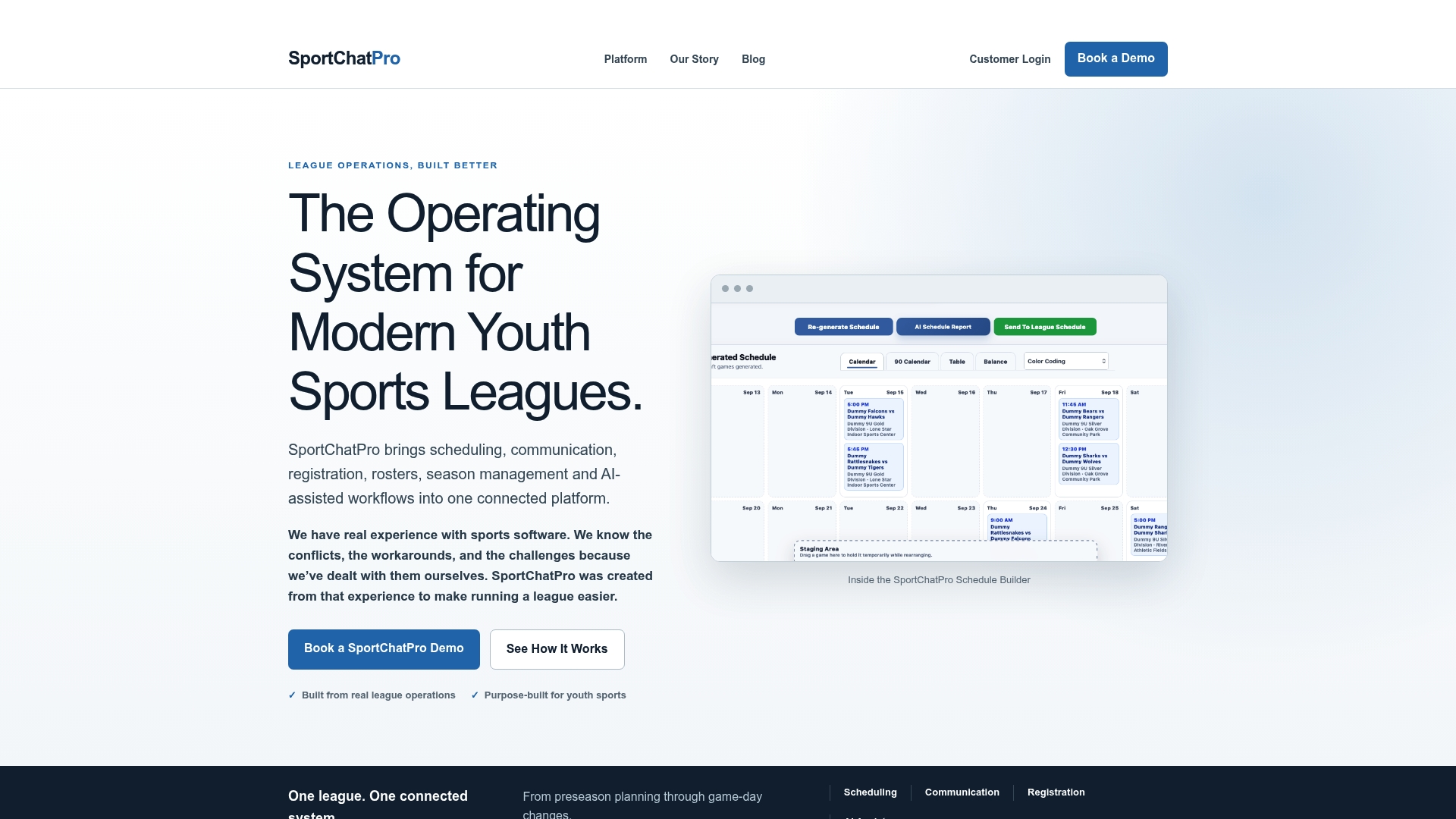
If your league is still piecing schedules together across spreadsheets and group texts, request a walkthrough of the SportChatPro Platform and see how conflict-aware scheduling holds up across a full season.
Primary sources and further reading
For the rules and research behind this guide, see Little League Regulation VII, the Little League Resource Guide, and peer-reviewed work on multi-league scheduling complexity and constraint programming for league scheduling.
Sources
- Little League Resource Guide
- Constraint Programming research on league scheduling (Dagstuhl 2025)
- Journal study on multi-league scheduling complexity and heuristics (2024)
FAQ
How do I create a league schedule?
Start by collecting facility hours, team counts, coach conflicts, and blackout dates, then write rules for minimum games, rest requirements, and daily game caps. Generate the entire season at once rather than week by week, and publish one canonical version with a stated change policy.
What is the best free schedule generator for sports?
There is no single tool that fits every league, since needs vary by size and field access; a shared spreadsheet with clear rules works for small, single-division leagues. Leagues juggling multiple divisions and shared fields tend to outgrow spreadsheets quickly and move to dedicated scheduling software.
What is the best sports scheduling software for youth leagues?
The right choice depends on league size and how many fields and referees you’re coordinating across divisions. Platforms like SportChatPro are built specifically around conflict-aware scheduling for youth leagues, checking field, coach, and referee availability against your rules before publishing.
Can I create my own schedule instead of using a service?
Yes, many smaller leagues build their own schedules with a spreadsheet and a clear set of written rules. As team counts and shared-field dependencies grow, manual scheduling gets harder to manage, and research on multi-league scheduling shows why larger, multi-division schedules benefit from joint, rules-based approaches rather than manual trial and error.
How many games should a youth team play per season?
Little League Regulation VII requires a minimum of 12 regular-season games per team, with many leagues scheduling around two games per week to reach that total. The exact count depends on season length, field availability, and the league’s own rules.